
How to Check for a Warrant in Denver County
Denver County keeps no full public warrant roster at the Sheriff Department, so start with the Denver County Court Public Portal. Case, docket, payment, and bond tools sit there, and each one answers a different question. The "Post Bond - Address Warrant" screen lists only matters you can handle online. A blank result there is not proof that no warrant exists, so treat it as one clue rather than the final word. Denver County Court handles municipal criminal cases, state misdemeanors, traffic matters, civil cases, protection orders, felony advisements, and preliminary hearings. Felony cases belong to Denver District Court. Juvenile, probate, and federal records live with separate custodians, so Denver County warrant questions rarely end at one counter.
- Check the DCC case and eligible bond tools using accurate data or a known case number.
- Review the docket for a future setting, but do not treat a calendar as a complete warrant list.
- Contact the criminal or traffic clerk for the case type and ask how to confirm present status.
- Use DCC or Denver Sheriff electronic records requests for an existing public record.
- For District, Juvenile, Probate, or federal matters, contact that court directly.
A Denver County warrant check does not run through CCIC or NCIC, since those systems serve criminal-justice agencies only. The Colorado Judicial Branch opens records by case and by document instead. A lawyer can confirm an order and map out the next step without leaning on stale third-party sites.
Denver County Portal Routes
The official DCC Public Portal bundles several Denver County Court services into one site. Case Quick Search takes a case number or an arrest-booking number. Searching a future date calls for a name and date of birth. The bond route accepts either, though it returns only bonds eligible for online posting.
| Route | Use | Limit |
|---|---|---|
| Case Quick | Known case or booking number | Not a full name roster |
| Future Date | Find a setting | Not warrant confirmation |
| Post Bond | Online-eligible bond matter | Not all warrants qualify |
| Docket | Hearing calendar | Narrow calendar purpose |
The court’s portal landing page shows these service tiles without private-person data.
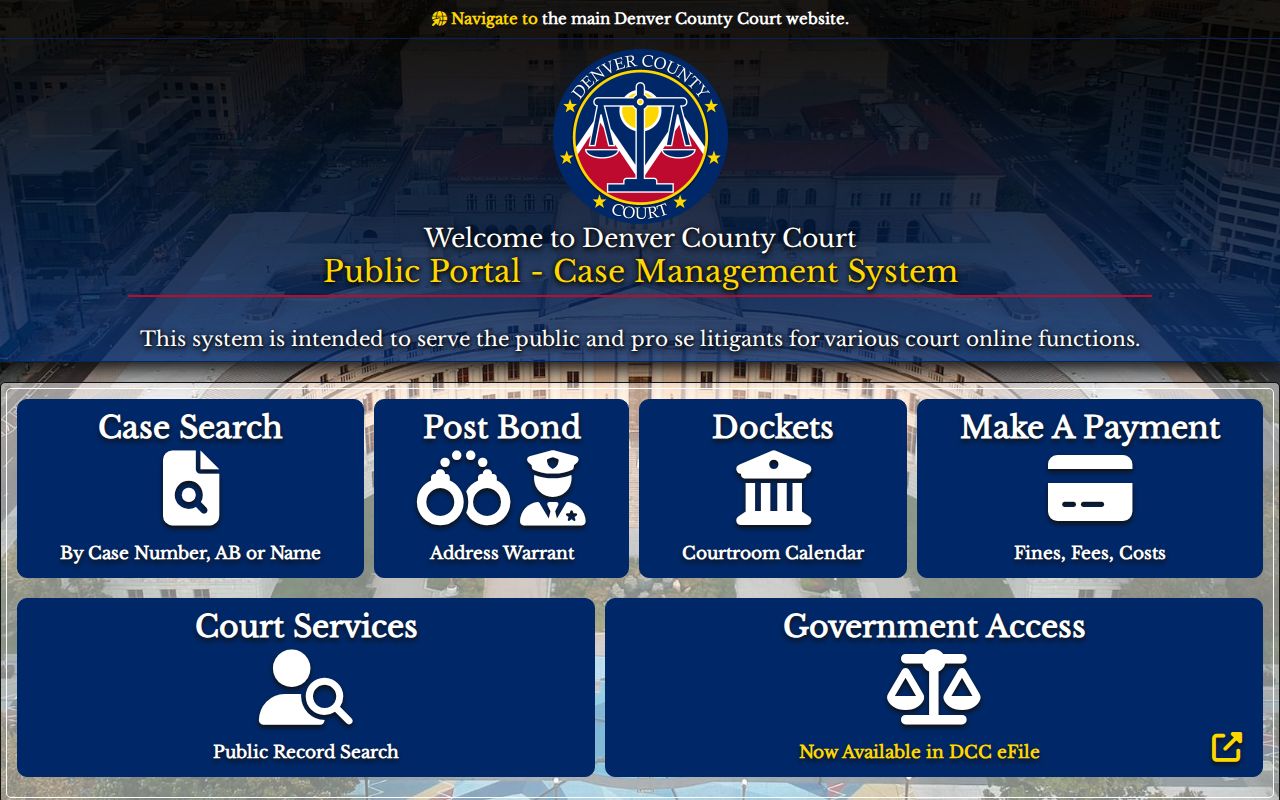
Split routes like these mean a blank screen on one path cannot settle every Denver County warrant question.
Types of Warrants in Denver County
Denver County courts issue different orders as a case moves along. A bench warrant typically follows a missed appearance or an unmet duty. An arrest warrant rests on a judge's probable-cause finding. Search, traffic, and municipal warrants stay tied to the case that created them.
| Type | Cause | Authority |
|---|---|---|
| Arrest | Probable-cause process | Judge or magistrate |
| Bench | Missed setting or noncompliance | Judge in the case |
| Search | Probable cause for a search | Judicial officer |
| Traffic or municipal | Unresolved local duty | Denver County Court |
SB25-062 bars failure to appear from forming the basis of a municipal criminal charge as the act addresses it. Denver County readers should note the limit. The law does not erase an existing hearing, contempt order, warrant, or court duty.
Denver County Records by Building
Denver's consolidated government still keeps its courts separate. Traffic and civil clerk work sits in Room 135 at the City & County Building, 1437 Bannock Street. Criminal and municipal clerk work sits in Room 160 at the Lindsey-Flanigan Courthouse, 520 West Colfax Avenue. The Bonding Office is on the first floor at 490 West Colfax Avenue. The current court contact page posts live hours and closures, so check it before any visit. These counters do not replace District Court for felony files.
Traffic and Civil Clerk
1437 Bannock St., Room 135
720-865-7840
Criminal and Municipal Clerk
520 W Colfax Ave., Room 160
720-337-0410
Bonding Office
490 W Colfax Ave., first floor
720-337-0062
The Denver County Court overview provides the court identity shown below.
That split matters because Denver County Court and Denver District Court answer different warrant questions in Denver County.
What a Denver County Warrant Record Shows
A Denver County warrant record may tie the order to a case number, allegation, hearing date, and bond decision. Fields differ by system. The sample 2026-CR-01234 is synthetic and matches no real case.
| Case or warrant number | Links the event to the issuing file. |
|---|---|
| Name and identifiers | Distinguish similar names; sensitive data may be withheld. |
| Charge or case type | An allegation, not proof of guilt. |
| Issuing court | The office that can confirm status. |
| Bond terms | Type, amount, eligibility, or review. |
| Status and dates | Issue, service, recall, clearance, or hearing. |
A Denver County police arrest record lists booking data and initial charges. It will not show the final court outcome.
Denver County Warrant Activity
Denver County Court's 2024 annual report counted 26,606 warrant entries and 19,861 clearances, with 52,146 outstanding at year end. Those are inventory totals. No names appear in it.
Numbers that large explain why a Denver County warrant check must be current. A cached page or old vendor record cannot establish an order's status today.
Who Issues and Serves Denver County Warrants
In Denver County, courts issue warrants. Denver County Court handles its own orders, and Denver District Court controls felony matters. The Denver Sheriff Department runs detention, court security, transport, extradition, and fugitive work. Denver Police serves verified orders too. DPD policy requires Denver 911 to confirm an NCIC wanted record before jail admission, which is one reason a public search page is never the final word on a Denver County warrant.
Court order → agency verification → service or arrest → return to the issuing court.
Denver County Warrant Terms
Read each status with its source date and issuing court.
- Active or outstanding
- The issuing authority treats the order as open; public visibility may lag.
- Bench warrant
- A judge’s order tied to a missed appearance or unmet court duty.
- Recalled or quashed
- The court formally withdrew the warrant.
- Bond
- Release and appearance terms; not every order has an online money option.
- ROA
- Register of actions, the court case history.
- FTA
- Failure to appear at a required setting.
Two legacy Denver functions, "Warrant Cancellation" and "Paid Name Search," are gone, so treat old snippets as history rather than instructions.
What to Do If You Have a Denver County Warrant
First confirm the issuing court and the warrant's current status. Then get legal advice on a voluntary appearance, bond, or a motion to recall or quash. Payment alone may not close the case if a sentence or appearance duty remains. The DCC Bonding & Warrants Division keeps the local records. Online bonding started in 2022, expanded in 2024, and eligibility still depends on the case.
Important: Speak with counsel or the issuing court before appearing; an active warrant can lead to arrest during police contact.
The official Bonding & Warrants page supplies the source shown here.
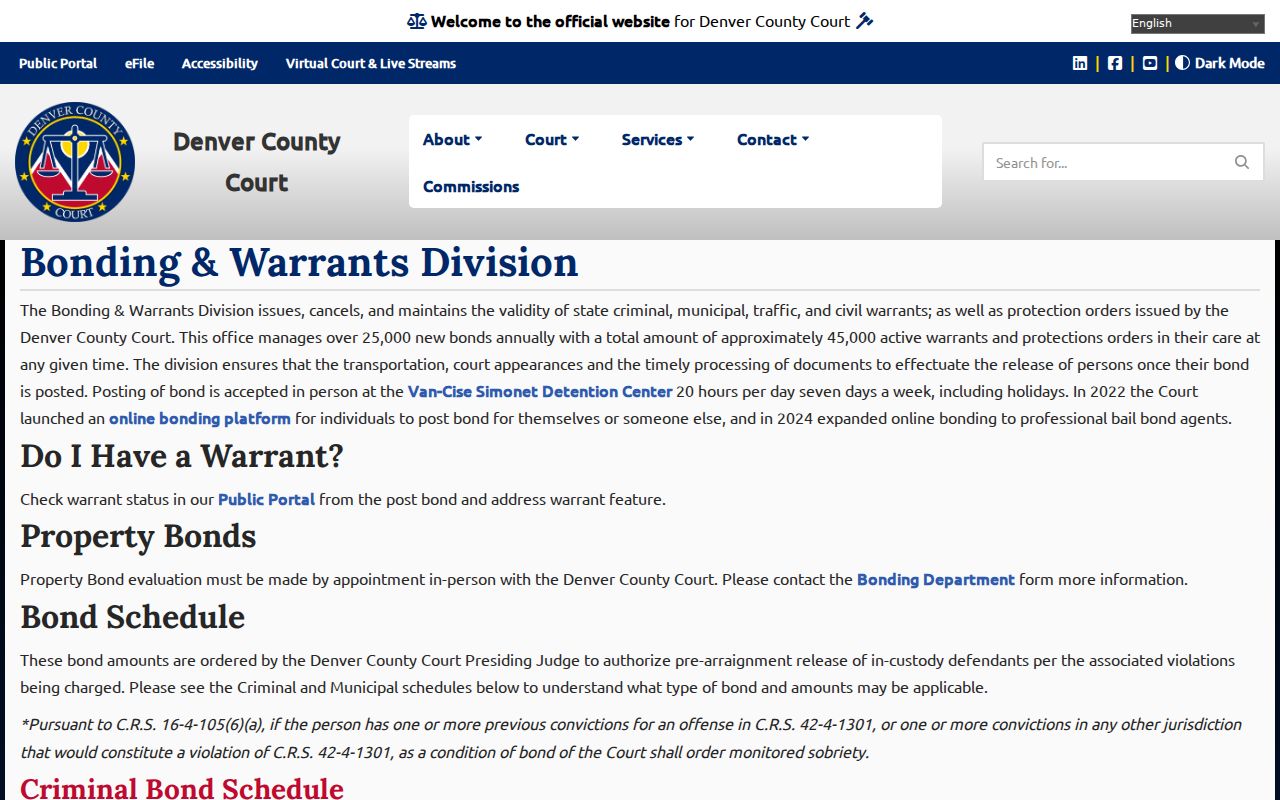
Official court guidance should control any plan to post bond or address a warrant.
Denver County Resolution Programs
Denver County offers several ways to resolve low-level cases outside the normal courtroom grind. Outreach Court works at community sites with service partners. In 2024 it resolved 414 cases for 202 people. Participants were connected to services. The program is a civic resolution route, not a blanket amnesty. The AID Center at 1370 Elati Street takes eligible low-level referrals and walk-in support. Its official service model asks no identification, no background check, and no citizenship question. Eligibility still turns on the offense and the program. Citizen Oversight Board reports also describe warrant-clearing events. A Roads to Recovery pilot ended in December 2024. A finished pilot is not a guaranteed current transport or release service. Each option must fit the offense, the court, and the program's present rules. The criminal or traffic clerk can identify the controlling case and its setting. Denver County's public defender route may help someone who qualifies for appointed counsel. A private lawyer can also ask the issuing court about recall, quash, bond, or surrender. No service agency can cancel a judge's order on its own. Recovery Court, announced in 2026, is another eligibility-based program in Denver County. Strong participation may support a reduced plea, a dismissal, or possible sealing under the program's terms. It is not a general warrant-clearing event. Confirm eligibility and referral details with Denver County Court before relying on it.
Public Access to Denver County Warrant Records
Access depends on who holds the record. Denver County Court applies its own rules under the Colorado Criminal Justice Records Act. Denver Sheriff and Denver Police each run separate request systems. The state Judicial Branch controls state court documents and warns that commercial vendor searches may be unofficial or incomplete.
Key Rules:
Colorado Criminal Justice Records Act permits fees, withholding, and redaction decisions.
Chief Justice Directive 05-01 sets public and limited state court access.
Judicial access guidance explains Denver’s separate administration.
Some Denver County records stay restricted, including sealed cases, juvenile matters, victim data, protected addresses, and CJIS, CCIC, or NCIC data. Public access never opens every field.
Denver County Records Requests
When a portal is not enough, ask the right office for an existing record. Denver County Court takes requests by email, mail, or in person, never by telephone or social media. The first 25 printed pages are free. Later pages cost $0.25, and work past the first hour may cost $41 per hour. The court need not create a custom report. Denver Sheriff requests use the electronic DSD route. State court documents use the Judicial Branch form. Provide a case number, court, document type, and date range when known.
Denver County Warrant Scam Check
Denver courts and agencies have warned about callers who claim a missed jury date or a warrant and then demand money. No real court calls to collect fines that way. Nor do they demand wire, cash, or phone payment. Hang up and call back on a published official number yourself.
Fraud warning: Do not trust a caller’s transfer, link, badge number, or percentage “bond”; verify through the court.
Read the official warrant scam warning before sending anyone money or personal data. A convincing caller may know your real address, a court name, or a public case fact. That knowledge does not make the demand valid. Do not call a number supplied in the message. Do not let the caller transfer you to a supposed deputy or clerk. Find the court's number on its official domain. Then ask the clerk to verify the case number and the correct payment path. Gift cards, cryptocurrency, wire transfers, cash drop-offs, and urgent telephone bond payments are all warning signs. A real Denver County warrant is handled through the issuing court and its authorized bond process. Save the message if it is safe to do so. Just do not publish its personal details or use it to confront the caller.
Denver County Court Boundaries
Every name can be spelled right. The search can still fail, because Denver County's courts split authority by case type. The Second Judicial District court page lists District, County, Juvenile, and Probate courts as separate constitutional courts. Denver County Court also hears municipal matters and defined state cases. Its felony work is limited to advisements, preliminary hearings, and review functions. A felony prosecution proceeds in District Court. The split shapes the records. A County Court case number will not open a District Court register of actions. A DSD custody result shows where someone is held, not whether another court has an open order. DPD records may hold arrest and initial-charge data, but the court holds the final outcome. Federal matters follow a separate route.
| Question | Starting point | Limit |
|---|---|---|
| Municipal, misdemeanor, traffic | Denver County Court | No felony clearance |
| Denver felony | Denver District Court | No municipal answer |
| Custody location | Denver Sheriff | No full warrant history |
| Police arrest record | Denver Police Records | No final outcome |
| Federal docket | PACER or federal clerk | No state status |
Reroute a mismatched Denver County inquiry. The state access guide warns that vendor results may be unofficial, outdated, or incomplete.
Denver County Bond Limits
Bond is one possible outcome, never a guarantee. Denver County Court reported 3,646 online bonds and 10,546 in-person bonds in 2024. Its totals also included $6.878 million in bonds and a highest online bond of $100,000. Those numbers show scale. They predict no one person's terms. The online route displays only eligible records. A judicial officer may require an appearance, set a personal-recognizance bond, impose conditions, or choose another lawful option. Personal recognizance means release on a promise to appear rather than an up-front cash payment. Out-of-county inquiries into a Denver County bond have a limited process for someone already held elsewhere. Before paying, confirm the case number, court, bond type, amount, and any separate appearance duties. Payment pages can redirect or go down for maintenance. A caller's urgent demand is never a substitute for the current court record.
Warrant Records by City in Denver County
Denver County has one incorporated city, because Denver is both city and county. Denver Police verifies wanted records. Denver Sheriff handles detention and court duties, while Denver County Court offers the local bench warrant process and bond routes. Denver County keeps every office under one roof.
Felony, juvenile, probate, and federal matters remain separate even within the city.